LEARN // EFFECTS
What is HDR emissive fire
HDR emissive fire is flame that adds its own light to the screen at brightness above plain white, so your engine's bloom makes the hot core glow and spill. Emissive means the flame gives off light instead of reflecting it, and HDR means its values can pass 1.0, which an ordinary 8-bit color image cannot hold.
- Godot 4 Available
- Unity Manual setup
- Unreal Engine Manual setup
- Roblox Studio Manual setup
- three.js Available
A draft compile is from $0.05, and new accounts start with $5 of usage.
01 // HOW IT WORKS
Why fire needs values above 1.0
A fire's core is many times brighter than the smoke around it. In an 8-bit texture both top out at 255, so fire stored as plain color looks like orange paper next to a lamp. Engines that render in HDR keep values above 1.0 until tone mapping, and bloom takes the pixels above a threshold and blurs them outward.
Fire and smoke want different treatment. Flame is emissive and usually additive, and scene lights should not darken it. Smoke is lit, absorbs light and uses alpha blending. Good fire effects keep the two in separate channels or separate materials.
02 // IN YOUR ENGINE
Make the flame glow in each engine
- Godot 4: Glow on the
WorldEnvironment, with the HDR Threshold under your flame's brightness. AnOmniLight3Dcasts the fire's light on nearby objects. - Unity (URP): HDR on in the URP asset, a Bloom override on a Volume, and an HDR emission color with intensity above 1.
- Unreal Engine: Emissive Color above 1 in an unlit Additive or Translucent material. Bloom is on by default.
- Roblox Studio:
LightEmissionnear 1 for additive glow, plusBrightnesson theParticleEmitter.
03 // REAL OUTPUT
Flame with a white-hot core
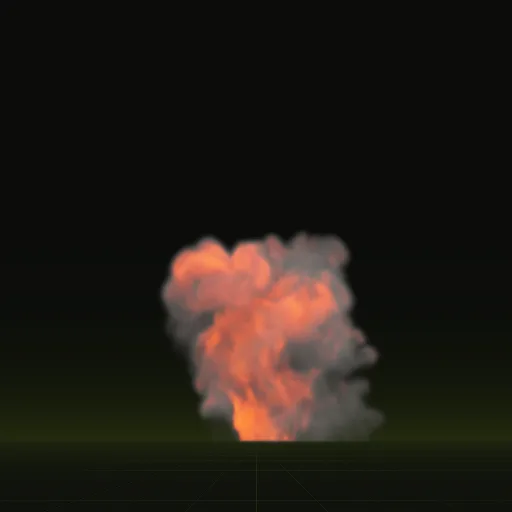
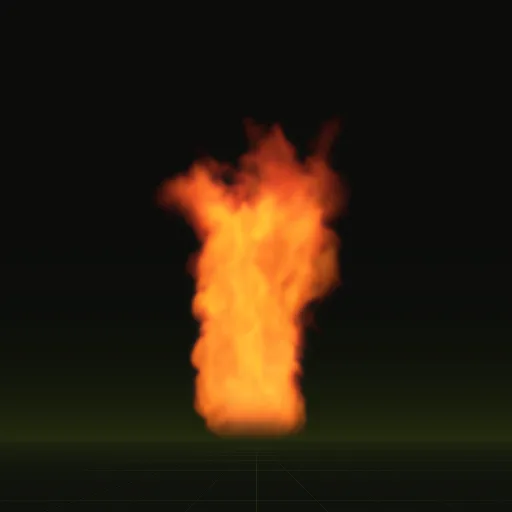
The fireball's core and the steady fire's base both run far above white in the compile, and bloom turns that into glow.
04 // SPATIAL COMPILER
How a compile keeps the brightness
A compile stores flame brightness in the alpha of main_neg.png as a square root against a per-clip maximum, which keeps the white-hot core in an 8-bit PNG. To decode it, square the alpha and multiply by scales.emit_max_hdr from layout.json; the flame color sits in main_colour.png. In Godot 4 the scene adds the flame as HDR light, so the environment glow can bloom it. See flame brightness.
How do I make a Niagara fire flipbook emissive and self lit?
Use an unlit Additive or Translucent material and multiply the flipbook by a brightness above 1 into Emissive Color for bloom.
When should I use 8 bit PNG instead of 16 bit or 32 bit EXR?
Use 8 bit PNG for shipping games to save memory and use EXR when you need exact HDR values for compositing.
How do I make a fire flipbook glow without lighting the smoke?
Keep flame on an unlit additive or emissive material and smoke on a lit alpha blended material so only flame triggers bloom.
Where should emissive data be stored for smoke and fire effects?
Store emissive intensity in its own channel, like the alpha of the second six way texture, using a square root or float format.
How do I make fire particles glow using LightEmission and Brightness?
Set LightEmission to 1, raise Brightness above 1, keep LightInfluence at 0 and place smoke on a separate emitter.
Compile your first effect
You pay per compile and see the price before it runs. New accounts start with $5 of usage.