EFFECTS // THREE.JS
How to make a fireball in three.js
In three.js, you can play a fireball that bursts from the ground and rolls upward in 3.7 seconds. A snippet loads the packed RGBA sprite sheet on a THREE.Sprite, sets the texture repeat to one eighth, and removes it after the last frame. Godot 4 gets a ready scene that relights the smoke.
- Godot 4 Available
- Unity Manual setup
- Unreal Engine Manual setup
- Roblox Studio Manual setup
- three.js Available
A draft compile is from $0.05, and new accounts start with $5 of usage.
01 // WHAT YOU GET
What you get for fireball in three.js
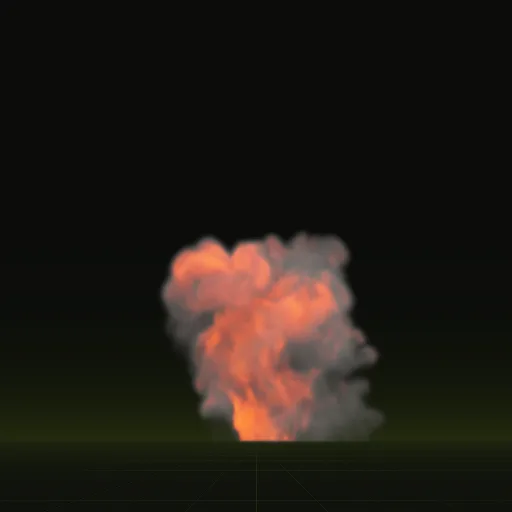
The fireball is a fuel explosion that bursts from the ground, swells, rolls at its edge and rises, about 9.4 m wide and 13.4 m tall at its peak. It plays once over 3.7 seconds. More of its 64 frames go to the fast first moments, so the burst does not look choppy.
You get four PNG sheets of 64 frames, a layout.json with the timing, and previews, which three.js plays through a small material.
02 // HOW TO
Play the fireball in three.js
- Ask your agent for the effect (for example "a fireball about half the size of the example, played once") with
export.packwriting the light from above into RGB and opacity into alpha, so one PNG holds gray shading you can tint. (main_pos.pngas it comes holds three light directions in RGB, not a color.) Load it withTextureLoaderand settexture.repeat.set(1 / 8, 1 / 8). - Put it on a
THREE.Spritewith aSpriteMaterial(transparent: true,depthWrite: false) so it always faces the camera. For the flame, make a second texture in an image editor,main_colour.pngmultiplied by the alpha ofmain_neg.pngsquared, and draw it on a second sprite withTHREE.AdditiveBlending. That texture is normalized, so restore the peak on the flame sprite withmaterial.color.setScalar(emitMax), whereemitMaxisscales.emit_max_hdr. - Each frame, pick the tile: column
i % 8and rowMath.floor(i / 8), then settexture.offset.set(col / 8, 1 - (row + 1) / 8). - The fireball's frames crowd its fast start, so pick
ifrom the clock:i = layout.frame_times_s.findIndex((t) => t >= elapsed). When that returns -1, after 4 s, callsprite.removeFromParent()andmaterial.dispose(). - Set
sprite.scale.set(s, s, 1)withsthe meters per tile fromlayout.json, a little over 13.4 m for the fireball, so it shows at its real size.
03 // ADJUST IT
Adjust the fireball for your scene
Use it for vehicles, fuel tanks and big set pieces. Ask your agent for a smaller fireball, a darker smoke cap, or several seeds so a chain of explosions does not repeat the same shape.
04 // SETTINGS
Settings in the fireball spec
A short burst of hot fuel starts at ground level and burns only where it meets air, so the ball burns at its rolling surface instead of all at once.
Ask your agent to change these and compile again; the full fireball spec lists every value.
Is there a fireball effect for three.js?
Yes. Ask your agent for a fireball about half the size of the example, played once, starting from the fireball example.
How do I play a fireball once and remove it in three.js?
Pick each frame from layout.frame_times_s, stop after frame 63 at 3.7 seconds, then call sprite.removeFromParent() and material.dispose().
How do I make a realistic fireball in three.js?
Start from a simulated explosion instead of manual particles. Hot fuel bursts at ground level and burns where it meets air.
How do I keep a fireball in proportion in three.js?
Keep the Sprite square because every tile is square. Set sprite.scale.set(s, s, 1) using the meters per tile from layout.json.
How many frames does the fireball effect use?
The fireball compile uses 64 frames over 3.7 seconds and gives more frames to the fast burst at the start.
Compile your first effect
You pay per compile and see the price before it runs. New accounts start with $5 of usage.