LEARN // EFFECTS
What is a particle system
A particle system is the part of your engine that spawns many small sprites or meshes from an emitter and updates each one every frame: position, speed, size, color, rotation and age. When a particle reaches the end of its lifetime it disappears. You tune spawn rate, shape, forces and curves to make sparks, smoke, rain or fire.
- Godot 4 Available
- Unity Manual setup
- Unreal Engine Manual setup
- Roblox Studio Manual setup
- three.js Available
A draft compile is from $0.05, and new accounts start with $5 of usage.
01 // HOW IT WORKS
The parts of a particle system
The emitter decides how many particles to spawn, where (a point, sphere, box or mesh surface) and with what starting values. Each frame the system applies forces such as gravity and drag, runs curves over each particle's age, and removes dead particles. A renderer draws the rest, usually as camera-facing quads with one material.
With a flipbook on that material, each particle plays its own animation, often from a random start frame. Most games show fire and smoke this way: the system handles motion and variety, and the flipbook supplies the detail.
02 // IN YOUR ENGINE
The particle system in each engine
- Godot 4:
GPUParticles3Dwith aParticleProcessMaterial, orCPUParticles3Dfor simple cases. - Unity includes a built-in Particle System that works in every render pipeline.
- Unreal Engine: Niagara, which replaced Cascade.
- Roblox Studio:
ParticleEmitter, set through properties such asRate,Lifetime,SizeandColor. - three.js: no built-in system. You update
THREE.Pointsor a set ofTHREE.Spriteobjects in your own loop.
03 // REAL OUTPUT
Effects built from emitters
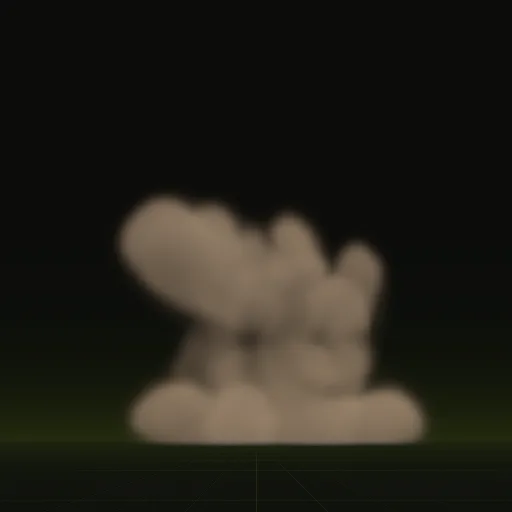
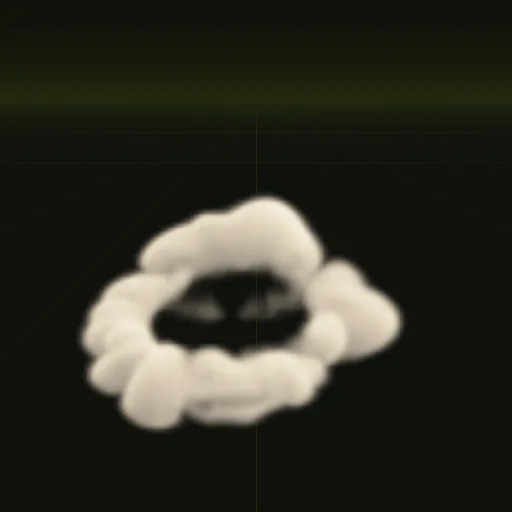
The impact was simulated from three emitters (a flash, thrown earth and a little smoke), and the dust ring from a burst along the ground.
04 // SPATIAL COMPILER
Precomputed flipbooks for your particles
Spatial Compiler compiles the flipbooks your particles play, and your engine's particle system places and times them. In Godot 4, wire with set: ["node=particles"] writes a GPUParticles3D that draws many copies of the effect. See Godot impact.
How do I set up the built in Particle System in Unity?
Add the Particle System component and configure its modules in the Inspector across any render pipeline, including physics collisions.
Is Cascade still the particle system in Unreal Engine?
No, Niagara is the standard particle system in Unreal Engine, while Cascade is deprecated and kept only for older projects.
What is the particle system in Godot?
Godot uses GPUParticles3D and GPUParticles2D with ParticleProcessMaterial for motion.
Does three.js have a particle system?
Not a built in one, so you use THREE.Points or THREE.Sprite and write your own update loop or use a library.
How do I randomize the size, color and lifetime of fire particles in Godot?
In ParticleProcessMaterial, set Scale Min and Max, assign a Color Initial Ramp and raise Lifetime Randomness.
Compile your first effect
You pay per compile and see the price before it runs. New accounts start with $5 of usage.