GUIDE // GODOT 4
How to use a flipbook texture with GPUParticles3D in Godot 4
Put the sprite sheet on a StandardMaterial3D, set its Billboard Mode to Particle Billboard and enter the grid in Particles Anim H Frames and V Frames. Then set Animation Speed to 1 in the ParticleProcessMaterial, so each particle plays the whole sheet once over its lifetime. Spatial Compiler can write this scene for you.
- Godot 4 Available
- Unity Manual setup
- Unreal Engine Manual setup
- Roblox Studio Manual setup
- three.js Available
A draft compile is from $0.05, and new accounts start with $5 of usage.
01 // HOW IT WORKS
Why a particle flipbook needs two materials
A flipbook texture, also called a sprite sheet, is one image that holds every frame of an animation in a grid. On a GPUParticles3D, the ParticleProcessMaterial gives each particle an animation phase from 0 to 1 as it ages, and the StandardMaterial3D on the draw pass turns that phase into one cell of the grid.
If you set up only one of them, every particle shows the whole sheet squeezed onto it or stays stuck on the first frame.
02 // HOW TO
Set up the flipbook by hand
- Add a
GPUParticles3Dnode and give it a newParticleProcessMaterialin Process Material. - Under Draw Passes, set Pass 1 to a new
QuadMesh, then give the quad a newStandardMaterial3Din its Material slot. - In that material, load your sheet into Albedo > Texture and set Transparency to Alpha.
- Set Billboard > Mode to Particle Billboard. In the Particles Anim fields that appear, set H Frames to the column count and V Frames to the row count, 8 and 8 for a 64-frame sheet.
- Turn on Vertex Color > Use as Albedo, so a Color Ramp in the process material can tint and fade the sheet.
- In the
ParticleProcessMaterial, open Animation and set Speed Min and Speed Max to 1. - Set the emitter Lifetime to how long one particle should take to play the sheet, for example 2 seconds for a 2 second clip.
A Speed of 2 plays the sheet twice per lifetime; turn on Particles Anim > Loop in the material for that, or the particle holds the last frame.
03 // WITH SPATIAL COMPILER
Let your agent write the emitter
Ask your agent to compile the effect and wire it as particles. It writes a scene with a GPUParticles3D (wire with node=particles) whose shader material plays the frames and lights the smoke from your scene's sun. Raise Amount when you want more copies.
The by-hand setup still works for any other sheet in your project, and the wired emitter's process material is a normal ParticleProcessMaterial you can edit. See Bake and wire.
04 // REAL OUTPUT
Sheets that play on a particle quad
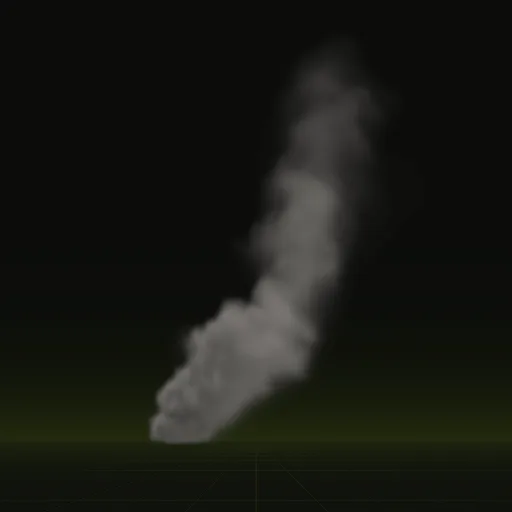
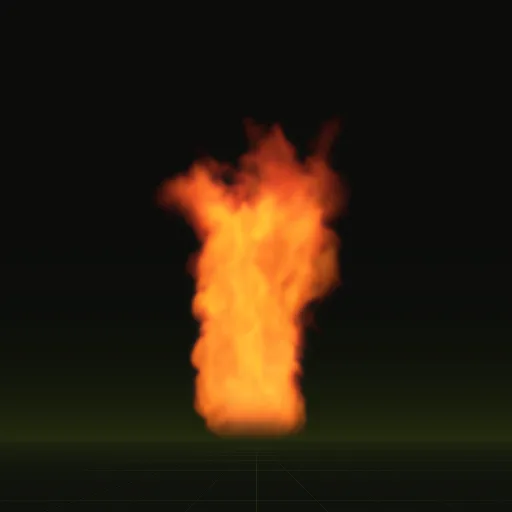
Each clip is 64 frames on an 8 x 8 grid.
How do I use a fire flipbook texture with GPUParticles3D in Godot?
Use the same material setup, then set Shading Mode to Unshaded and Blend Mode to Add so fire glows over what sits behind it.
How do I use a smoke sprite sheet in a Godot particle system?
Keep Shading Mode on Per Pixel and Blend Mode on Mix so scene lights reach the smoke and match particle Lifetime to puff length.
How do flipbook particles work in Godot?
Each particle carries an animation phase that the process material advances as it ages and a Particle Billboard material displays the matching cell.
Where do I set the rows and columns of a flipbook in Godot?
In StandardMaterial3D under Billboard and Particles Anim, set H Frames for columns and V Frames for rows after enabling Particle Billboard mode.
How does a Godot particle material know how many frames are in the sheet?
It multiplies H Frames by V Frames and treats every cell as a frame, so fill the grid to avoid blank flashes.
Compile your first effect
You pay per compile and see the price before it runs. New accounts start with $5 of usage.